Testing & buying guidance
Adjustable Bed Performance: What to Measure Before Choosing a Base
An adjustable base is a piece of furniture with a small repertoire of movements and a surprisingly large effect on the bed around it. It raises the head, lifts the feet, and promises a more accommodating night. The useful question is not how many buttons it has, but how well it performs the movements you will actually use—and whether it fits your mattress, room, and habits.
A practical comparison of lift range, noise, stability, controls, clearance, and compatibility.
Start with the position, not the feature list
Adjustable-bed descriptions often arrive dressed for a trade show: preset modes, massage functions, wireless remotes, app controls, USB ports, and carefully named positions. Some may be welcome. But the base’s basic task is mechanical. It must move a loaded mattress smoothly, hold the chosen position without wobble, and return to flat without turning a quiet room into a small construction site.
Before comparing models, decide what adjustment is meant to accomplish in your own sleep setup. You might want a modest head lift for reading, a raised upper body for comfort, or a change in leg position. Perhaps two sleepers have different preferences, or one person needs to sit up more easily. The intended use determines which measurements matter. A base with extensive movement may be unnecessary if you expect to use one gentle incline; a limited range may disappoint if you want to raise both the head and feet substantially.
It helps to distinguish a feature from a performance measure. “Independent head and foot adjustment” tells you what the base can attempt. It does not tell you how far it moves, how long the movement takes, whether it strains under your mattress, or whether the resulting position feels stable. Those are questions to test, not infer from a product name.
Measure the lift range in useful terms
Lift range is the distance and angle through which the head and foot sections can move. A manufacturer may specify degrees, but those numbers can be hard to translate into the experience of lying in bed. If you can test a base in person, move it through its full range while lying on the mattress. Notice the point at which the position becomes useful, then the point at which it begins to feel awkward. The maximum is not automatically the best setting.
Check the head and foot sections separately, then together. Does the head lift enough for the positions you expect to use? Can the foot section rise without forcing your knees into an uncomfortable angle? When both sections move, does the shape feel supportive, or does the mattress seem to bunch or pull against the frame? A base’s range is only practical if the mattress can follow it without resisting in ways that alter comfort.
Ask whether the advertised range is measured without a mattress or under a specified load. A movement demonstrated with nothing on the frame may not represent the motion under the weight of a mattress and bedding. If a showroom model is available, test it with the mattress in place. At home, keep people and loose objects clear of moving joints and follow the manufacturer’s operating instructions.
Record what you observe rather than relying on memory: starting position, approximate time to reach your preferred incline, whether movement is continuous, and whether the base pauses or jerks. These notes make a comparison more useful than a vague impression that one model “went higher.”
Listen to the movement
Noise is easy to overlook in a bright showroom and hard to ignore at bedtime. Motors, hinges, and the contact points between a frame and the floor can all contribute. The question is not merely whether the base makes a sound; almost any powered mechanism will. Listen for its character and consistency. A steady, subdued motor is different from a sharp clunk at startup, a rattle near the end of travel, or a squeak that comes and goes as the frame flexes.
Test the base more than once. Raise and lower the head, then the foot, and try a combined movement if the model allows it. Pay attention to whether the sound changes under load or near the limits of travel. If you share a room, consider testing from the sleeping position rather than standing next to the bed. Distance, bedding, and the quiet of night can change how noticeable a sound feels.
Ask about motor warranty and service arrangements as well as decibel claims, if provided. A noise specification may be useful for comparing products tested under the same conditions, but it cannot capture every bedroom’s acoustics or every person’s tolerance. A retailer’s demonstration offers evidence; it is not a guarantee of the sound level in your home.
Check stability at rest and in motion
A base can operate quietly and still feel unsettled. Stability is worth evaluating in two states: while the platform moves and after it reaches a position. Watch for side-to-side sway, vibration, or a delayed shudder when movement stops. Once the base is still, test whether ordinary shifts in position produce a distracting bounce or frame noise.
Consider the way you sleep and use the bed. A person who tends to sit near the edge may notice perimeter movement more than someone who stays near the centre. A couple may care about whether one side’s adjustment disturbs the other. If the base is split, determine which sections move independently and whether both sides can be controlled without unexpected movement on the other side. Do not infer independence from the appearance of two separate mattresses; confirm how the actual base is built and operated.
Use the bedding you plan to keep, if possible. A mattress protector, fitted sheet, topper, and heavier duvet all affect how the sleep surface behaves as it bends. Look for bunching, slipping, or tension across corners. The fitted sheet should stay secure through the range you expect to use, and the mattress should not seem to migrate as the platform changes position.
Some frames include features intended to help keep a mattress in place. Confirm whether those retainers are included, compatible with your mattress, and easy to install. Stability depends on the assembled system—base, mattress, legs, floor, and bedding—not on the frame in isolation.
Make the controls pass a simple test
A control should be easy to use when you are tired, in low light, and not interested in studying a manual. Try the remote without being coached through it. Can you distinguish head adjustment from foot adjustment? Are the buttons arranged in a way that makes sense? Do they require a long press, a double press, or a sequence that is likely to be forgotten?
Look for clear feedback. A backlit remote may help at night, while tactilely distinct buttons can be more useful than a bright screen. If the base uses an app, ask whether basic movement still works without a phone, an account, or a reliable internet connection. Test what happens after a power interruption and find out how to return the bed to a flat position if the remote is misplaced or the electronics stop responding.
Presets can be convenient, but a list of named positions is not itself evidence of good design. Try saving or recalling a position if the base allows it. Check whether a preset moves both sections, whether it can be interrupted easily, and whether the control lets you make a small correction without starting over. For shared beds, ask whether each sleeper has access to the controls they need.
Extra features should be judged by frequency of use. A massage function or charging port may be useful to some households; it should not distract from a weak motor, confusing remote, or poor return-to-flat function. Prioritize the controls and movement you expect to rely on week after week.
Treat compatibility as a system check
The base and mattress need to work together. Some mattresses are designed to flex; others may be unsuitable for repeated articulation. Check the mattress manufacturer’s guidance before buying a base, and ask the base manufacturer for its own compatibility requirements. Confirm whether the warranty permits use on an adjustable frame and whether there are limits on the type of support surface.
Construction can matter. A mattress that flexes comfortably in a store may behave differently when adjusted at home, particularly if it is thick, heavy, or paired with a topper. Observe whether it follows the platform smoothly, stays seated on the frame, and returns to a level shape when lowered. Do not assume that a mattress’s comfort or material category alone determines compatibility; verify the specific model and instructions.
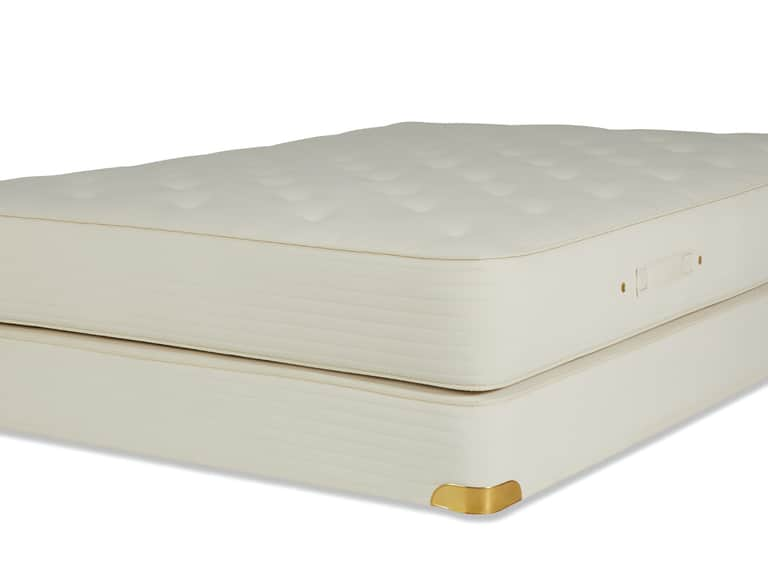
For instance, the Naturally Organic Hudson Latex Mattress is listed as compatible with an adjustable base. That product detail is a useful starting point, not a substitute for confirming the base’s dimensions, operating limits, and warranty terms. If you are considering another mattress, check its individual specifications rather than assuming that a similar construction has the same approval.
Also review the mattress’s thickness and weight against the base’s recommendations. A heavy mattress can place different demands on the mechanism than a lighter one, while an unusually thick model may affect how the bed moves or how the bedding fits. Confirm whether the base has a mattress-retention bar, whether it is necessary for your setup, and whether it interferes with the mattress or frame.
Measure the room, the floor, and the clearance
Before delivery, measure the bed’s footprint in both flat and raised configurations. The frame may not occupy a larger floor area as it moves, but a raised headboard, nearby wall, nightstand, window treatment, or low ceiling can become an obstacle. Check that cables will not be pinched and that the moving sections have room to travel.
Under-bed clearance is another practical detail. If you store boxes beneath the bed, measure their height and account for the frame, legs, and motor components. Some bases have a low profile; others stand higher or use legs that can be changed. Confirm whether leg height is adjustable and whether the options affect stability or the overall setup. If the base sits inside an existing bed frame, verify its external dimensions and the space available within that frame, not just the mattress size printed on the label.
Consider the floor. Uneven surfaces, slick flooring, and rugs can affect how a base sits and whether it shifts. Ask whether the unit needs particular floor protectors or a specific assembly method. If the base has wheels or adjustable feet, find out how they lock and whether the instructions recommend a particular floor covering.
Delivery logistics belong in the measurement process. Check doorways, stairs, tight turns, and elevator dimensions. A base may arrive in sections, but that does not mean every piece will fit through every route. Clarify assembly, packaging removal, and the process for moving or servicing the unit later.
A repeatable comparison beats a showroom impression
When comparing two bases, use the same sequence on each. Begin flat. Raise the head alone, then the foot, then both if available. Lower the platform. Listen at startup, during travel, and when the motor stops. Test the controls from the bed. Sit in the position you expect to use and shift gently to assess stability. Finally, inspect how the mattress and bedding behave throughout.
A simple scorecard can keep the comparison honest. Rate each item from one to five, but add a note explaining the score. “Quiet” is less helpful than “low, even motor sound; one light click at stop.” “Stable” is less helpful than “no noticeable sway when still; slight movement during head adjustment.” The description preserves what mattered and makes it possible to compare products later.
- Lift range: Does the base reach the positions you expect to use?
- Movement: Is travel smooth under the mattress, without abrupt starts or stops?
- Noise: Is the sound even and acceptable from the pillow?
- Stability: Does the frame feel composed while moving and at rest?
- Controls: Can you operate the essential functions without instruction?
- Compatibility: Are the mattress, bedding, and frame approved for this setup?
- Clearance: Will the base fit the room, route, and under-bed storage plan?
- Support: Are warranty, service, and power-failure procedures clear?
Scores are a means of organizing judgment, not a scientific verdict. A small difference in a score may be less important than a feature that affects daily use. If one base is quieter but has controls you find baffling, the trade-off matters. If you never plan to use a massage function, its presence should not outweigh a poorly fitting frame.
Read the warranty and the limits of the test
Before purchasing, read the warranty rather than relying on a summary. Look for coverage of the motors, frame, electronics, and remote, and note how long each is covered. Check whether the warranty is limited, whether labour or transport is excluded, and what conditions could affect coverage. Ask how a malfunction is diagnosed and who arranges service.
Understand what the warranty does not tell you. A long coverage period does not prove that a base will be quiet, comfortable, or easy to operate. Nor does a successful brief demonstration establish long-term durability. In a short test, you can assess fit, movement, noise, controls, and immediate stability. You cannot reproduce years of repeated use on a showroom floor.
Where possible, use a trial or return policy to evaluate the base in your actual room, with your mattress and bedding. Confirm the return window, pickup charges, restocking fees, and any packaging requirements in writing. A generous policy can reduce the risk of discovering too late that a control is inconvenient or that the frame makes a sound you noticed only after the house went quiet.
Choose for the ordinary night
The most persuasive adjustable-bed feature is often the one that disappears into routine. The base moves when asked, stops where expected, and leaves the rest of the bed feeling settled. That is less theatrical than a catalogue of presets, but more consequential. A quiet motor and intuitive remote may matter more over a year than a function tried once on delivery day.
Begin with your habits, then test the mechanics against them. Measure the movement you need, listen closely, check how the system holds still, and make sure the mattress and room are compatible. The point is not to find the base with the largest number of claims. It is to find one whose performance makes the bed easier to use without asking you to think about the mechanism at all.